What is the registro de jornada and who must keep it?
Article 34.9 of the Estatuto de los Trabajadores (Workers' Statute) says that the company shall guarantee a daily record of working time, which must include the specific start and end time of each employee's working day. It was added by Royal Decree-law 8/2019, published in the BOE on 12 March 2019, which made it apply two months after publication.
According to the Ministry of Labour guide on the working-time record (Spanish), it applies to all employees, whatever their category, in all sectors and in all companies, whatever their size. It expressly includes people who work fully or partly away from the workplace: sales staff, mobile and temporary workers, and remote workers.
- Senior management: senior management staff (art. 2.1.a ET) are excluded, according to the guide. As a rule, middle managers and positions of trust with flexible hours are still recorded.
- Part-time: part-time work already had its own record (art. 12.4.c ET): hours are recorded day by day and totalled each month, and the employee gets a copy of the summary with the payslip. If this record is not kept, the contract is presumed to be full-time unless proven otherwise.
- Overtime: art. 35.5 ET requires working time to be recorded day by day and totalled per pay period, with a copy of the summary on the payslip. The guide says the art. 34.9 record can also be used for this.
- Temp agencies and subcontractors: for agency workers the user company keeps the record; for subcontracting, the contractor, as the employer (Ministry guide).
What the record must contain and how to keep it
- Minimum content: the specific start and end time of each person's working day, every day (art. 34.9 ET).
- Breaks: the Ministry guide advises recording breaks too. Otherwise all the time between clock-in and clock-out may be presumed to be working time.
- Who decides the system: the record is organised by collective agreement or company agreement or, failing that, by the employer after consulting the workers' legal representatives (art. 34.9 ET).
- Format: the law sets none. According to the guide, any system on paper or electronic is valid if it gives reliable information that cannot be changed or manipulated afterwards, by the employer or the employee, and ensures traceability.
- Privacy: if the system uses digital devices, video surveillance or geolocation, the privacy rights of art. 20 bis ET and Organic Law 3/2018 on data protection apply, as the guide points out.
Retention and access: four years, always available
| What | Rule (source) |
|---|---|
| Daily record | Start and end time of each person's working day, every day (art. 34.9 ET). |
| Retention | Four years (art. 34.9 ET). |
| Access | Available to employees, their legal representatives and the Labour and Social Security Inspectorate, whenever they ask (art. 34.9 ET · Guide). |
| Where | At the workplace, or immediately accessible from it (Ministry guide). |
| Copies | No general duty to hand out copies unless agreed, but personal consultation must be possible (Ministry guide). |
| Part-time | Monthly summary, with a copy given with the payslip; summaries kept for at least four years (art. 12.4.c ET). |
| Overtime | Totalled per pay period, with a copy of the summary on the payslip (art. 35.5 ET). |
What happens if there is no record?
Article 7.5 of the Law on Social Order Infringements and Sanctions (LISOS) classes breaches of the rules on working time, rest and the working-time record, among others, as a serious infringement. Its article 40.1.b sets fines for serious infringements of €751 to €1,500 (minimum degree), €1,501 to €3,750 (medium degree) and €3,751 to €7,500 (maximum degree).
Is a digital time record mandatory?
Not yet. Spain's Ministry of Labour has published a draft royal decree on its public participation portal that would develop the working-time record and require it to be kept by digital means. As of 18 October 2026 it has not been published in the BOE (Spain's official gazette): it is a draft, it is not in force and it has no date of entry into force. Today art. 34.9 ET applies, and it does not require any particular format.
If it is published, we will review this guide and the app against the final text.
Step by step in Odoo with Registro Jornada Spain
Our app Registro Jornada Spain (l10n_es_hr_registro_jornada) builds the working-time record on top of Odoo Attendances (hr_attendance): clocking in stays the same, by kiosk, systray or manual entry. It works on Odoo 17, 18, 19 and 20, Community and Enterprise, on Odoo.sh or on-premise.
- Install the app. The Setup checklist opens (later: Registro de jornada › Configuration › Setup checklist). It lists employees without a working schedule, without an ID document or without a date of birth (used to apply the limits for minors), who cannot sign online, and forgotten check-outs, each with a button to fix it.
- In Configuration › Settings, match the alerts to your collective agreement: maximum ordinary hours per day (9 by default), minimum rest between workdays (12 hours), break after 6 hours (at least 15 minutes) and weekly, monthly and yearly alerts. By default, correcting an attendance requires a reason.
- In the same settings, retention cannot go below 48 months, the four years of art. 34.9 ET. Automatic deletion after that period is optional and off by default.
- In Configuration › Break types, review the default breaks (rest break, paid rest break “bocadillo” of up to 15 minutes, meal break, personal matters and medical visit) and mark which are paid under your agreement. Paid breaks count as working time.
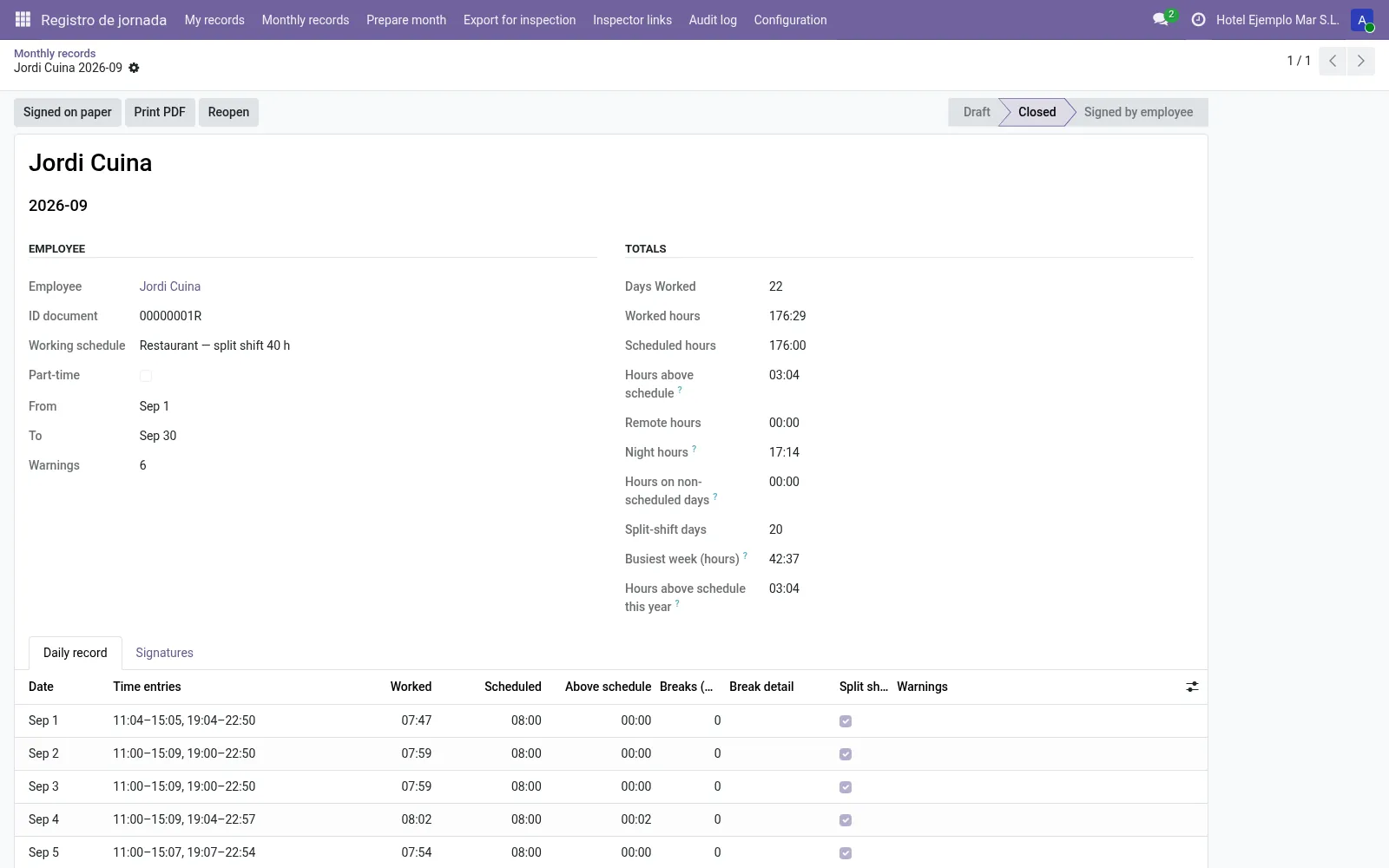
- Employees clock in and out as usual. Each attendance can be marked on site or remote, with the type of the preceding break. Per workday the app computes worked hours, breaks, split shifts, night hours (22:00–06:00), remote hours and hours above schedule, and warns about excess hours, missing breaks or rest, missing check-outs, overlaps and scheduled days without a record. Every attendance creation, change or deletion goes to the Audit log, append-only, chained with SHA-256 and verified daily.
- Each month the records for the previous month are prepared automatically (or use Prepare month). Review the warnings, correct attendances with a reason and click Close month: the attendances of that month are locked. Only an administrator can reopen it, and must give a reason.
- Employees sign under My records or in the portal (
/my/working-time, also on a phone); with the default setting they get an e-mail with the link. Paper signatures are registered with Signed on paper. With Download my data, each person gets their own record and change history. - When the inspectorate or the workers' representatives ask, create a link in Inspection › Inspector links: read-only, limited to a period and a set of employees, with an expiry date (at most 30 days by default) and revocable; every use is logged. Or use Export for inspection: the daily record as CSV, JSON or XML, the monthly records as PDF and the audit trail as CSV.
What the app does not do
- It does not decide which hours are overtime. “Hours above schedule” is a daily figure; how it is classed depends on your collective agreement and the annual distribution of hours.
- It does not replace the collective agreement, company agreement or consultation with the workers' representatives on how the record is organised.
- It does not hand out the monthly summaries with the payslip for you (part-time and overtime); the monthly PDF with the month's totals is a basis for them.
- It sends nothing to the inspectorate or to Normalane: the data stays in your Odoo. The inspectorate only sees it if you create a link or export.
- Gaps between attendances without a break type count as unpaid breaks, unless you set a default break type.
- Signing in Odoo or the portal is a simple electronic signature (login, time and IP address).
- It does not run on Odoo Online, which does not allow third-party modules.
What if someone edits the database directly? The audit log cannot stop a person with full database access, but such changes break the chain and the daily check reports them.
Ready to use Registro Jornada Spain?
€24, one-time, per Odoo version. Bought and downloaded on the Odoo Apps Store.
Frequently asked questions
Is a working-time record mandatory for every company in Spain?
Yes. According to the Ministry of Labour it applies to all companies, whatever their size, and to all employees, remote workers included. Senior management staff are excluded.
How long must the records be kept?
Four years (art. 34.9 ET), available to employees, their legal representatives and the labour inspectorate. The app does not allow less than 48 months.
What is the fine for not keeping a working-time record?
It is a serious infringement (art. 7.5 LISOS), with a fine of €751 to €7,500 depending on the degree (art. 40.1.b LISOS).
Is a digital time clock mandatory?
No, as of 18 October 2026. The Ministry of Labour has a draft royal decree that would require it, but it has not been published in the BOE. Today any reliable system, on paper or digital, is valid.
Do breaks have to be recorded?
The law requires the start and end time. The Ministry guide advises recording breaks too, so that the whole time between clock-in and clock-out is not presumed to be working time. The app supports break types, paid or unpaid.
Does it change how my employees clock in?
No. The app works on top of standard Odoo Attendances: kiosk, systray or manual entry. It adds the monthly record, signatures, alerts and the change log.
How does the labour inspectorate see the records?
Through a read-only link you create, limited to a period and a set of employees, with an expiry date and revocable, or through an export as CSV, JSON, XML or PDF. Every access is logged.
Official sources
Each link goes to the official page or publication the facts above come from.
- BOE: Workers' Statute, consolidated text, art. 34 (Spanish) · Daily record with start and end time, organised by agreement or employer decision after consultation, four-year retention, access for employees, representatives and the inspectorate (art. 34.9)
- BOE: Workers' Statute, art. 12.4.c (Spanish) · Part-time: daily record, monthly total with a copy given with the payslip, four years, presumption of full time
- BOE: Workers' Statute, art. 35.5 (Spanish) · Overtime: daily record totalled per pay period
- BOE: Royal Decree-law 8/2019 of 8 March (Spanish) · Adds art. 34.9 ET (art. 10); applies two months after publication (sixth final provision, section 4)
- Ministry of Labour: guide on the working-time record (PDF, Spanish) · All companies and employees, senior management excluded, breaks, any reliable unalterable system, access at the workplace, copies, temp agencies and subcontractors
- BOE: LISOS (Royal Legislative Decree 5/2000), art. 7.5 (Spanish) · Serious infringement for breaches on the working-time record
- BOE: LISOS, art. 40.1.b (Spanish) · Fines of €751 to €7,500 for serious infringements
- Ministry of Labour: draft royal decree on the working-time record (PDF, Spanish) · Draft that would require a digital record (art. 2)
- BOE, checked on 18 October 2026 · No royal decree on the working-time record published
Email support@normalane.com with your Odoo version and edition (Community or Enterprise). Bug fixes for the purchased Odoo version are free.
This guide explains public rules in plain language. It is not legal or tax advice. Normalane is not affiliated with Spain's Ministry of Labour or the Labour and Social Security Inspectorate.